
CAHIP

By Anne Kelly
Thesis: California is trying to slow healthcare spending growth to 3.5% in 2025-2026 and 3.2% in 2027, while hospitals seek higher commercial reimbursement, carriers absorb pharmacy and utilization trend, federal coverage subsidies are shifting, and employers are receiving renewals that feel disconnected from the state affordability target.
At first glance, the 2026-2027 renewal cycle can look like another painful year of medical inflation. But the more carefully one looks, the more it appears that multiple pressure systems are colliding at once. The collision is especially visible in California, where the Office of Health Care Affordability (OHCA) has begun putting a public benchmark around what used to happen mostly behind closed doors: how fast healthcare spending should be allowed to grow.
This article argues that the current market friction is not simply a carrier-pricing story or a hospital-pricing story. It is a deeper affordability crisis in which provider reimbursement, pharmacy inflation, chronic disease, public-payer pressures, Covered California subsidy changes, Medi-Cal eligibility changes, and employer risk-pool dynamics are converging. The result is a market in which hospitals and carriers are increasingly “at each other’s throats” when contracts come up for renewal, while employers continue to receive Q4 2026 and Q1 2027 renewal increases that often exceed the state’s cost-growth target by a wide margin.
1. The OHCA benchmark: a new public yardstick
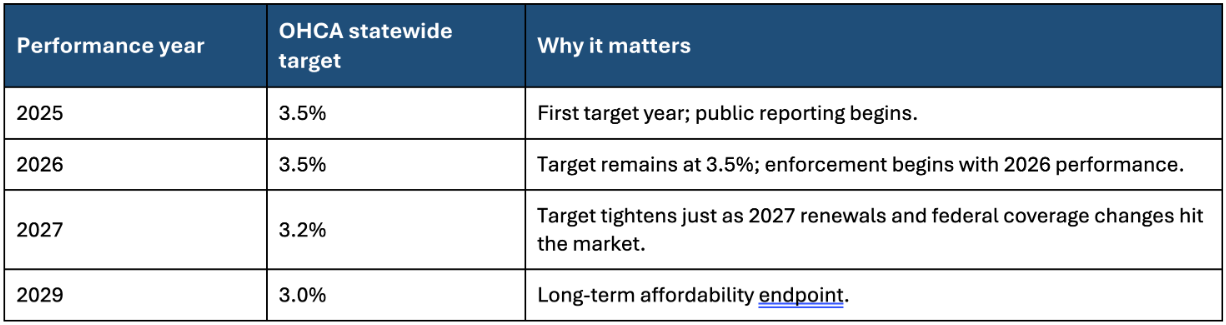
OHCA’s statewide spending target begins at 3.5% for performance years 2025 and 2026, drops to 3.2% for 2027 and 2028, and reaches 3.0% in 2029. The target is not a premium cap. It is a per-capita health spending growth target intended to signal that healthcare spending should not continue to grow faster than California household income.
That distinction matters. Employers buy premiums, not abstract medical trend. A carrier renewal can be driven by more than provider reimbursement: pharmacy costs, utilization, risk adjustment, population morbidity, reserves, administrative costs, benefit mix, and product-specific experience all play a role. Still, the OHCA target changes the conversation. It creates a public affordability benchmark against which carriers, hospitals, and large physician organizations can increasingly be judged.
“The larger point is that cost containment may increasingly depend not only on negotiated discounts, but on care model design.”
2. The baseline: carriers were already above the target
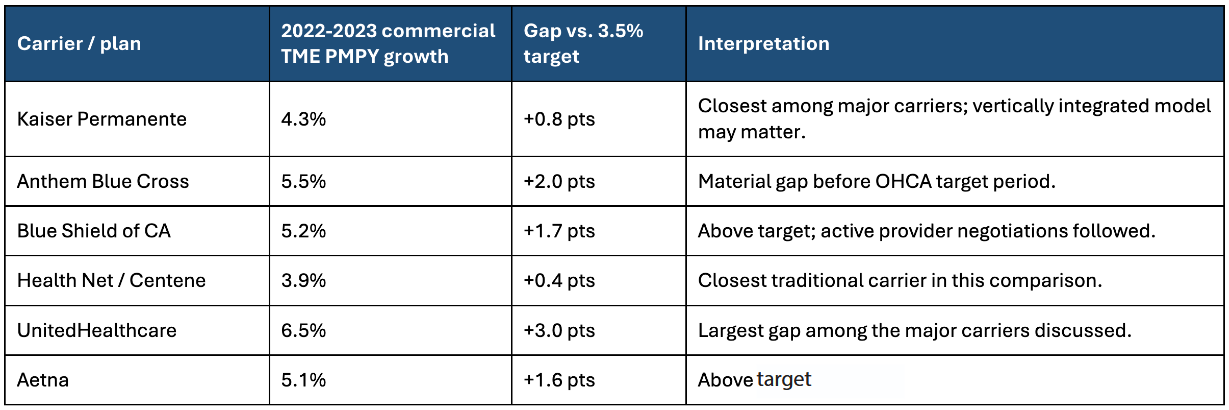
OHCA’s Baseline Report: Health Care Spending Trends in California, 2022-2023 established the pre-target landscape. Among major commercial carriers, medical expense growth was already generally above the later 2025 target. In simplified terms, the market was operating around 4% to 6.5% commercial total medical expense growth before the 3.5% target took effect.
This does not mean those carriers “failed” OHCA in 2023. The target had not yet taken effect. It does mean California is asking the market to slow a trend that was already running meaningfully above the target before the measurement era began.
3. Why hospitals and carriers are fighting harder
The hospital-carrier conflict is driven by a simple arithmetic problem. Hospitals argue that labor, nurses, physicians, drugs, supplies, technology, capital costs, seismic and regulatory compliance, and public-payer reimbursement pressure are all rising. Carriers argue that they cannot accept provider price demands that would push employer premiums and consumer costs even higher, particularly while the state is measuring the system against a 3.5% or 3.2% target.
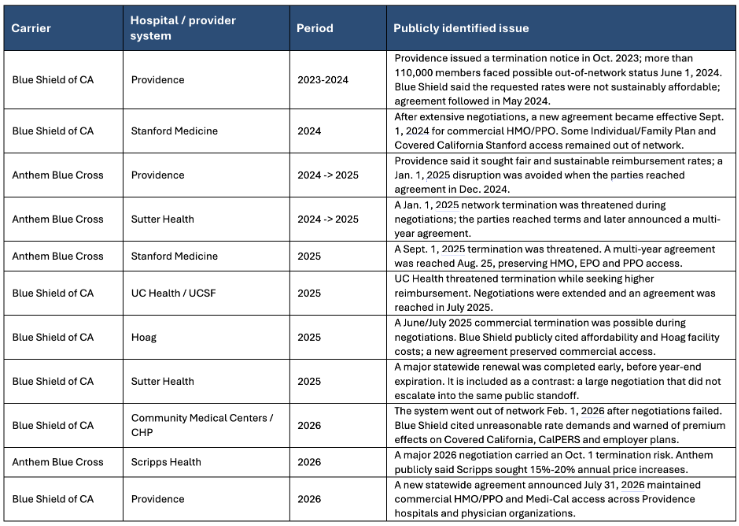
The contract table is where those pressures collide. If a hospital system seeks a large commercial reimbursement increase, a carrier has only a few options: accept the increase and eventually reflect it in premiums; reject the increase and risk network disruption; or accept part of it and try to recover savings elsewhere through utilization management, narrow or high-performance networks, prior authorization, site-of-care management, pharmacy management, or value-based contracting.
4. Public California contract disputes show the pressure
The current contract friction did not suddenly appear with the 2025 OHCA target. Public negotiations were already escalating in 2023 and 2024, then continued across a wider group of major California systems in 2025 and 2026. The timeline below is not an exhaustive census of every confidential negotiation; it highlights well-documented disputes and threatened network terminations that show the trend.
The trend is the important point. The 2023-2024 Providence-Blue Shield confrontation predates OHCA enforcement, so OHCA cannot fairly be described as the cause of these disputes. But by 2025-2026, multiple large California systems were simultaneously pressing Anthem and Blue Shield over reimbursement and network terms just as the state began measuring spending growth against 3.5% targets. The Scripps-Anthem dispute makes the arithmetic particularly visible: a publicly alleged 15%-20% annual provider price request is not directly comparable with OHCA total expenditure growth, but it demonstrates the gap carriers may be trying to reconcile at the negotiating table.
5. Kaiser’s vertical model: not immune, but structurally different
Kaiser Permanente is not exempt from cost pressures. It faces labor, drug, technology, and utilization pressures like every other healthcare organization. But its model is structurally different. Kaiser describes itself as combining health coverage and care delivery into one coordinated experience, with the health plan financing care delivered through Permanente physicians, hospitals, and medical facilities.
It also describes its physicians as salaried and the model as aligning incentives around coordinated care rather than volume.
That difference matters. A traditional carrier must negotiate rates with independent hospital systems and physician groups for access to its network. Kaiser’s core delivery system is more vertically integrated. That does not automatically make Kaiser cheaper in every market or every product, but it may help explain why Kaiser often appears to have somewhat lower trend in certain public comparisons. The larger point is that cost containment may increasingly depend not only on negotiated discounts, but on care model design.
6. Q4 2026 and Q1 2027 renewals: what is weighing on small and large group
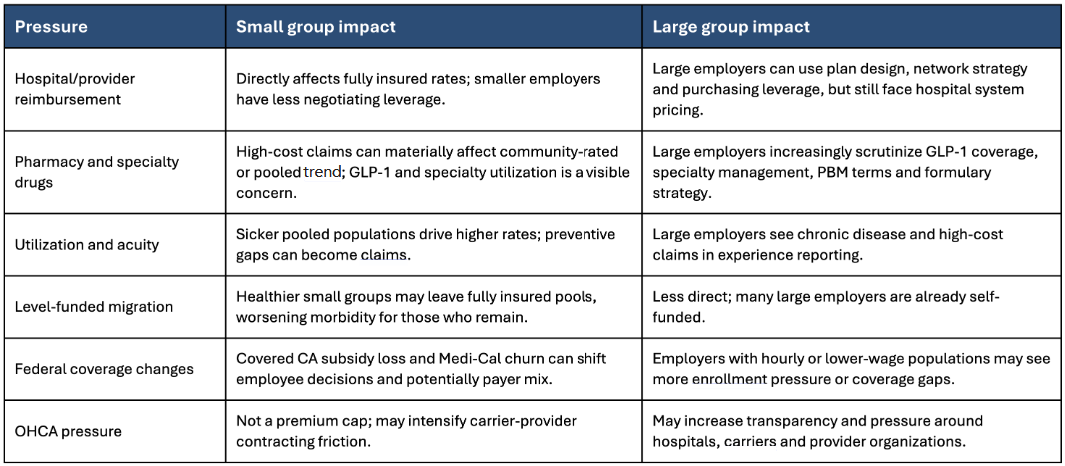
For Q4 2026 and Q1 2027, brokers should be prepared to explain that renewal increases are not being driven by one factor. They are being driven by a stack of pressures.
National small-group filings show the same pattern. KFF’s review of 2027 filings found a median proposed small-group premium increase of about 14%, with insurers citing rising medical prices and utilization, high-cost specialty drugs, GLP-1 utilization, behavioral health utilization, declining enrollment, and worsening risk-pool morbidity; some filings specifically attribute the worsening fully insured risk pool to the rise of level-funded arrangements among healthier small employers.
Aon’s 2027 employer forecast points in the same direction for the broader employer market: U.S. employer healthcare costs are projected to rise 9.5%, with utilization, chronic conditions, high-cost claims, specialty medications, GLP-1 therapies, and even provider coding/documentation technology contributing to cost pressure.
7. Covered California and Medi-Cal changes add another layer
The individual market and public coverage changes are not the same thing as employer renewal trend, but they are part of the same healthcare financing ecosystem. Covered California announced a preliminary weighted average rate increase of 9.9% for 2027, with Anthem at 13.0%, Blue Shield at 12.5%, Health Net at 13.2%, Kaiser at 6.7%, and the overall marketplace at 9.9%. Covered California attributed the increase to rising healthcare costs, pharmacy expenditures, broader industry challenges, and federal actions including the failure to extend enhanced federal tax credits.
Covered California had already reported the impact of the subsidy change in 2026: new enrollment was down 32%, middle-income renewals that lost all enhanced premium tax credits had a 22% cancellation rate, and more than 130,000 renewing Californians switched to Bronze plans.
At the same time, DHCS states that H.R. 1 Medi-Cal changes are expected to affect up to two million Medi-Cal members. Beginning January 1, 2027, certain expansion adults face work or community-engagement rules unless exempt, and some members must renew Medi-Cal every six months rather than annually.
These changes may affect employer markets indirectly. Some lower-wage employees who lose or churn off Medi-Cal may look to employer coverage. Others may remain uninsured. Hospitals may experience payer-mix pressure and uncompensated-care concerns, while carriers and employers may see enrollment behavior change. These are emerging risks rather than fully proven causes of current employer premium increases, but they are important to watch.
8. The underbelly: chronic disease and the American diet
The financing conversation can miss the deeper utilization question: why are so many Americans consuming so much healthcare in the first place? CDC states that 90% of the nation’s $5.3 trillion in annual healthcare expenditures are for people with chronic and mental health conditions.
That means any serious affordability conversation must include chronic disease, not merely unit prices.
The post-World War II and especially post-1970 food environment changed dramatically. USDA data show that between 1970 and 2003, food available for consumption increased 16%, calories increased by 523 calories per person per day, added fats and oils rose 63%, grain consumption rose 43%, sugars and sweeteners rose 19%, and corn sweetener consumption increased 400%. A later USDA review noted that about two-thirds of U.S. adults were overweight or obese in 2003-2004 compared with 47% in 1976-1980, and that the adult obesity rate more than doubled from 15% to 32%.
It would be too simple to say the American diet is the only cause of the healthcare cost crisis. Aging, smoking history, inactivity, alcohol use, environmental exposure, socioeconomic conditions, administrative complexity, medical prices, provider consolidation, technology, and drug innovation all matter. But it is reasonable to argue that population health is the upstream cost driver that makes every downstream financing problem harder.
The Broker’s Message: Premium is the Symptom, Disease Burden is the Cause
For employers, the renewal conversation often begins and ends with the percentage increase. But brokers can add value by explaining the chain underneath the number:
- Poor population health and chronic disease
- Higher utilization
- Higher medical and pharmacy claims
- Hospital revenue pressure and carrier claims pressure
- More contentious provider negotiations
- Higher employer premiums and employee cost sharing.
If the market only negotiates lower prices after people are already chronically ill, it may slow trend but it will not cure the affordability problem. Long-term healthcare cost containment must include primary care, nutrition, metabolic health, obesity prevention, diabetes reversal and prevention, behavioral health, musculoskeletal health, medication adherence, early cancer detection and better site-of-care decisions.
Conclusion: California is Entering a Healthcare Affordability Stress Test
OHCA did not create the healthcare cost problem. Hospital consolidation, drug costs, chronic disease, utilization, public-payer shortfalls, employer risk-pool erosion and administrative complexity were already present. But OHCA may be forcing the conflict into the open by placing a public target on spending growth at the same time carriers, hospitals, employers and consumers are all under stress.
The question for California is not simply whether the state can impose a 3% cost-growth trajectory. The question is whether the healthcare system can change enough to live within that trajectory. That requires more than rate negotiation. It requires care-model redesign, pharmacy strategy, primary-care investment, administrative simplification, better use of technology, and a far more serious commitment to improving the metabolic and chronic-disease profile of the population.
For brokers and consultants, this is the story behind the renewal: premiums are the visible number, but the battle underneath is over who absorbs healthcare inflation that remains far above the affordability target. The broker who can explain that larger system collision will be better equipped to guide employers through the difficult 2026-2027 renewal cycle.