
HEALTH & WELLNESS

By: Megan Wroe, MS, RD, CNE, CLEC
Movement: Your Most Powerful Tool for Longevity and Independence
My guess is that you and all of your clients have at least thought about starting or improving your exercise routine this month as it is the natural way for most of us to start the year. But for adults moving through middle age and beyond, the underlying reason for making fitness goals is not simply getting stronger or losing weight. The real reason we exercise—even if we do not consciously think about it—is to maintain independence, prevent falls, protect daily functions, and build sustained confidence in navigating the world around us for the decades ahead. Just as we invest in savings and retirement plans for sustainable living in the future, we should be investing in movement now, so our future bodies can live independently without pain and discomfort.
As brokers, you see firsthand the downstream financial and personal impact of disability, chronic disease, and lost independence. Research has shown time and time again that fitness is the single most influential modifiable factor for long-term healthspan outcomes. While diet, sleep, and stress management matter deeply, research in lifestyle medicine consistently shows that fitness is the top determinant of longevity, functional independence, and quality of life as we age.
In addition to January being the time to set new year goals, Fitness Professionals Week also occurs during this month, so it is the perfect moment to honor the role of trained movement specialists in helping adults age safely, confidently, and successfully; and to remind clients and communities that restarting or progressing forward in exercise routines should always be done with the goal of long-term function, not short-term exhaustion.
Movement Is the #1 Predictor of Independence and Longevity
Fitness is more than strength or stamina—it is a direct predictor of healthspan. Large population studies show that cardiorespiratory fitness and muscular strength are among the most accurate predictors of all-cause mortality, surpassing many traditional biomarkers when adjusted for age.
Research in journals such as Sports Medicine, JAMA Internal Medicine, and multiple American College of Lifestyle Medicine publications show the following outcomes repeatedly within a variety of populations:
- Walking speed and grip strength reliably predict longevity and functional independence.
- Resistance training as little as one to two times per week reduces disability risk by roughly 20%, independent of weight loss.
- Increased fitness status reduces hospitalization, ER utilization, and fall severity, all of which drive healthcare costs and reduce patient quality of life.
- Regular movement improves balance, cognition, metabolic health, and emotional wellbeing, which are all key components of healthy aging.
One of the highest-risk issues for older adults is falls, which are a leading cause of ER visits, hip fractures, loss of independence, and long-term disability. In fact, for those over the age of 65, a fall that includes a hip or femur break increases mortality within the following year by 15 to 30 percent. Training that builds balance, leg strength, stimulation response, and endurance is more effective for fall prevention than any pharmacological intervention currently available so should be a priority in health routines for all adults. Consider movement as medicine that continues to compound over time.
The Four Core Elements of Functional Movement for Aging Well
Healthy aging requires more than cardio or strength training alone. In order to develop functional movement capacity, we must focus our fitness efforts across four movement domains: endurance, resistance, high intensity, and mobility. Before feeling overwhelmed, know that each of these domains intersect and can be done concurrently with the right fitness plan, and each can be started gently, progressed safely, and modified for any physical condition. Let’s review each domain individually.
1. Endurance, aka Zone 2 Cardio
Zone 2 is steady-state activity done at a conversational pace. It is any consistent activity that is gentle enough to maintain breathing comfortably but challenging enough to raise heart rate. It improves metabolic flexibility, cardiovascular health, mitochondrial function, blood sugar regulation, and stamina. Examples include fast paced walking, swimming, cycling, light dance, etc. For a beginner, start with 10 minutes of easy walking, cycling, or swimming, three to five days per week. Progress gradually toward 20 to 30 minutes at a time, with the goal being 150 minutes per week. Sample modifications may be a recumbent bike or indoor treadmill for joint discomfort, an indoor walking track or supported walking with railings for fall risk, or an arm bike for leg paralysis.
2. Resistance Training, aka Muscle Building
Muscle mass naturally declines with age, leading to weakness, slowed gait, difficulty rising from the floor or chair, and higher fall risk. Resistance training preserves muscle, bone density, walking ability, metabolic health, and core strength. For a beginner, start with one set of eight to 10 light repetitions in the major muscle groups twice weekly. Examples would be chair stands, wall pushups, resistance bands, light dumbbells, or Pilates reformer exercises. Progress slowly to two or three sets with stable form, with the goal being a minimum of three resistance training sessions per week. Sample modifications may be shorter ranges of motion and slowed tempo for arthritis, bands for weak grip strength, or seated weightlifting.
3. High-Intensity Exercise, aka Power
As we age, we lose power and speed if we do not force ourselves to practice them. This slows reaction time, which becomes a major fall-risk factor. Short bursts of higher-effort work improve neuromuscular responsiveness, agility, and critically, cardiovascular health. For a beginner, warm up first of your favorite cardio exercise, then do a 20 to 30-second sprint as fast as you can, then follow with a one- to two-minute recovery. Repeat once or twice and progress each week with slightly longer sprints or more repetitions, with the goal being no more than once per week sprint sessions. Sample modifications would be to use a bike, NuStep, arm ergometer or even kickboard in the pool drills as sprints rather than running or jumping for lower intensity on joints.
4. Mobility & Flexibility
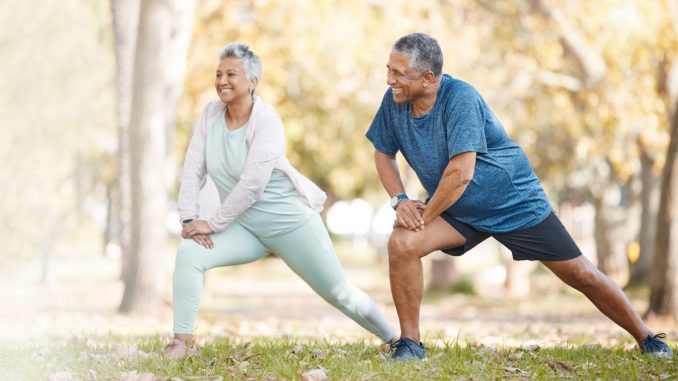
Stiffness, limited range of motion, and loss of balance increase fall risk and create fear of movement. This type of exercise is often a final thought and may even be left out of a session to save time, but increased muscle mass without mobility only creates joint pain and reduced functional movement down the line. Mobility work improves gait confidence, posture, joint health, foot stability, and core control. For a beginner, start with five minutes of light mobility movement, with the goal being 15 minutes per day, ideally divided throughout the day. This can be in the form of tai chi, gentle yoga, ankle/hip stability, floor stretches, or Pilates. Sample modifications include using a wider stance or elevated surface for neuropathy concerns, or tools like straps, balls and blocks to do stretches in appropriate format.
Why Professional Guidance Matters
As movement needs become more specific with age, professional guidance elevates safety, success, and confidence. Fitness professionals, physical therapists, yoga therapists, and clinical exercise specialists offer:
- Safe form and joint alignment
- Gradual progression strategies
- Balance and gait analysis
- Fall prevention programming
- Post-rehab movement planning
- Condition-specific modifications (especially in Medical Fitness Certified facilities like St. Jude Wellness Center)
For any adult trying to restart or progress fitness goals, exercising without guidance can lead to preventable injuries and often preventable falls and ER visits. Professionally guided programs dramatically improve adherence and functional outcomes.
Celebrating Fitness Professionals Week at St. Jude Wellness Center
In honor of Fitness Professionals Week, St. Jude Wellness Center is offering a $20 discount off of a Fitness Program Design during the entire month of January. During this session, a personal trainer certified in medical fitness will create a fitness plan that their client can safely and independently follow to start meeting their fitness goals. After their program design, clients are encouraged to participate in any of our medical fitness programs focused on balance, strength, and functional fitness.
Anti-Inflammatory Masterclass Series Launches in January
For those who are not local enough for a Fitness Program Design but interested in whole-body health and how to take steps toward longevity, we also have a virtual masterclass starting soon. Our Anti-Inflammatory Masterclass Series blends evidence-based education on fitness along with nutrition and recovery with practical strategies to help participants build sustainable habits that support longevity, energy, and metabolic health. It’s an excellent option for Medicare recipients, employers, or anyone looking for a structured, supportive path to better wellness. Individuals can register on our Programs & Events page. If employers or groups are interested in private versions of the course, reach out to me to discuss options, as I am always happy to modify in order to bring education to the community.
 Megan Wroe, MS, RD, is a registered dietitian and Manager of St. Jude Wellness Center, an integrated program of Providence St. Jude Medical Center. She leads a multidisciplinary team providing nutrition, fitness, mind-body therapies, and preventive wellness services that support the hospital’s mission of whole-person care. Megan partners with community organizations and insurance professionals to advance preventive health strategies that help reduce chronic disease risk, promote healthy aging, and improve quality of life for Medicare and senior populations. From single offering services and packages, to virtual comprehensive programs for larger employee populations, the wellness center team will create a wellness package based on the health needs and interests of your clients and groups. Learn more about the wellness center and their upcoming programs online St. Jude Wellness Center – Welcome to St. Jude Wellness Center
Providence St. Jude Medical Center
megan.wroe@stjoe.org
www.stjudewellnesscenter.org
Featured in our January Special Issue 2026 page 52 – Click here to download!
Sources: